


This is part 1 of our three-part series on the fundamental factors that shape our perception of high-fidelity sound reproduction.
Part 1: The impossibility of the perfect sound transducer
Part 2: You hear perfectly… differently
Part 3: You hear how you reside
This article offers an insight into one of the greatest engineering challenges in audio reproduction: the design of loudspeaker drivers – the electroacoustic transducers responsible for converting the electrical output of an amplifier into the sound waves that ultimately reach our ears. It is written for music lovers who enjoy home Hi-Fi but find themselves discouraged by the often impenetrable technical jargon of the high-end audio community, or who remain sceptical of the marketing claims surrounding modern Hi-Fi and home cinema equipment. By the end of this article, you should be able to ask yourself the right questions when selecting and setting up loudspeakers, allowing you to make informed decisions based on engineering principles rather than advertising promises.
Because the underlying physics of sound radiation quickly becomes mathematically complex, we will stay as close as possible to the listening experience itself. Our aim is to explain the engineering compromises behind loudspeaker design in terms that relate directly to what we actually hear, helping you distinguish between the characteristics that genuinely matter and those that are largely irrelevant to musical enjoyment. Throughout the article we also provide references for readers wishing to explore the subject in greater depth.
From Electrons to Molecules
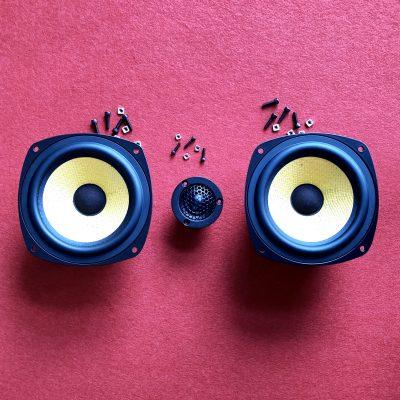
In the following pages we focus primarily on the electrodynamic loudspeaker driver, by far the most common transducer technology used in modern loudspeakers. Whenever appropriate, we also refer briefly to alternative technologies that have earned a reputation among high-end enthusiasts.
The physical phenomenon made use of in an electrodynamic loudspeaker is that whenever an electrical conductor carrying current is placed within a magnetic field, it experiences a force whose direction and magnitude depend on the polarity and amplitude of the electrical signal. In a Hi-Fi system this signal is supplied by the power amplifier – or, in the case of active loudspeakers, by the amplifier built directly into the loudspeaker enclosure.
The motor of a loudspeaker therefore consists essentially of two components: a voice coil, through which the music signal flows, and a magnetic circuit, which converts the electrical current into mechanical force. The voice coil is mechanically connected to the loudspeaker diaphragm. As the coil moves back and forth under the influence of the music signal, the diaphragm follows, transferring kinetic energy to the surrounding air. This alternating motion creates the pressure fluctuations that propagate through the room as sound waves. In simple terms, the larger the effective diaphragm area and the greater its excursion, the greater the volume of air displaced – and therefore the higher the achievable sound pressure level. Voilà.
At this point, we will deliberately skip over the remaining design principles of loudspeaker drivers, as the internet and the technical literature already offer more than enough high-quality resources on the subject. Instead, we will turn our attention directly to some of the more common topics where marketing claims and practical relevance tend to diverge.
Force and Masses
At first glance, designing an ideal loudspeaker driver appears straightforward.
The diaphragm should respond instantly to every change in the electrical signal, faithfully reproducing even the smallest transient. Unfortunately, physics has other ideas.
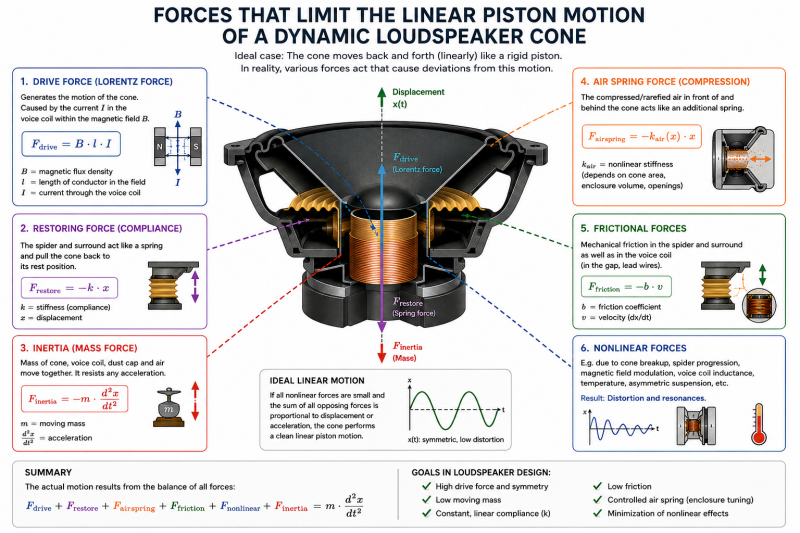
Every moving component possesses inertia. Before the voice coil can change direction, it must first overcome its own mass. Added to this are the mass of the diaphragm itself, the compliance of the surround, the restoring force of the spider, and numerous other mechanical elements that resist motion. Two opposing design goals therefore emerge immediately. On the one hand, engineers seek to maximise motor force in order to accelerate the moving system as rapidly as possible. On the other hand, they aim to minimise moving mass, reducing inertia and improving transient response. These objectives, however, inevitably conflict.
Increasing motor strength generally requires larger magnetic assemblies and more substantial voice coils, both of which increase mass. Conversely, making the diaphragm thinner and lighter eventually compromises stiffness, durability, thermal stability, or all three. This represents one of the fundamental optimisation problems in loudspeaker engineering – a compromise that cannot be eliminated by clever design alone.
No practical electroacoustic transducer can reproduce an electrical input signal with perfect mechanical fidelity.
Importantly, this limitation is not unique to moving-coil loudspeakers. Electrostatic and planar magnetic drivers face analogous trade-offs, albeit arising from different physical mechanisms.
Fortunately, ideal electrical step functions are not part of real musical performances. Moreover, the recordings we enjoy have themselves been created, mixed, and mastered using loudspeakers that are subject to exactly the same physical limitations. That observation will become important later in our discussion.
The X-Axis
In a loudspeaker driver, engineers strive to confine all motion to a single degree of freedom: a perfectly linear back-and-forth movement, commonly referred to as pistonic motion. Maintaining this ideal motion is far more challenging than it might appear. The magnetic circuit, voice coil, diaphragm, surround and spider are all arranged concentrically around the same mechanical axis. Any deviation from this alignment introduces nonlinearities, increased distortion and, in severe cases, mechanical rubbing or failure. Consequently, manufacturing precision and quality control become defining characteristics of a high-quality driver – and, inevitably, significant contributors to its cost.
Even under ideal conditions, however, diaphragm excursion along this x-axis is limited. Typical Hi-Fi woofers may provide peak excursions approaching ±20 mm, while long-throw drivers intended for home cinema or automotive applications often exceed these values considerably.
Yet maximum excursion tells only part of the story. Long before a driver reaches its mechanical limits, its behaviour gradually departs from linearity. Suspension components become progressively stiffer, restoring forces no longer remain proportional to displacement, and maintaining perfectly centred motion becomes increasingly difficult. As excursion increases, the diaphragm is asked to reproduce ever more complex waveforms while simultaneously moving greater volumes of air. This explains why many inexpensive subwoofers can produce impressive bass output yet struggle to reproduce the fine detail and articulation that distinguish accurate low-frequency reproduction from mere loudness.
The magnetic motor presents further challenges. As the voice coil moves in and out of the magnetic gap, the portion immersed in the region of uniform magnetic flux changes continuously. Consequently, the driving force is no longer perfectly constant throughout the excursion. At the same time, the electrical inductance of the coil varies with position, modifying the electrical load seen by the amplifier and introducing subtle but measurable colourations. Modern driver manufacturers devote considerable engineering effort to reducing these nonlinearities through optimised magnetic geometries, copper shorting rings, aluminium sleeves, undercut pole pieces and other techniques. While these measures significantly improve performance, none can eliminate the underlying physical mechanisms entirely.
The Y-Z-Plane
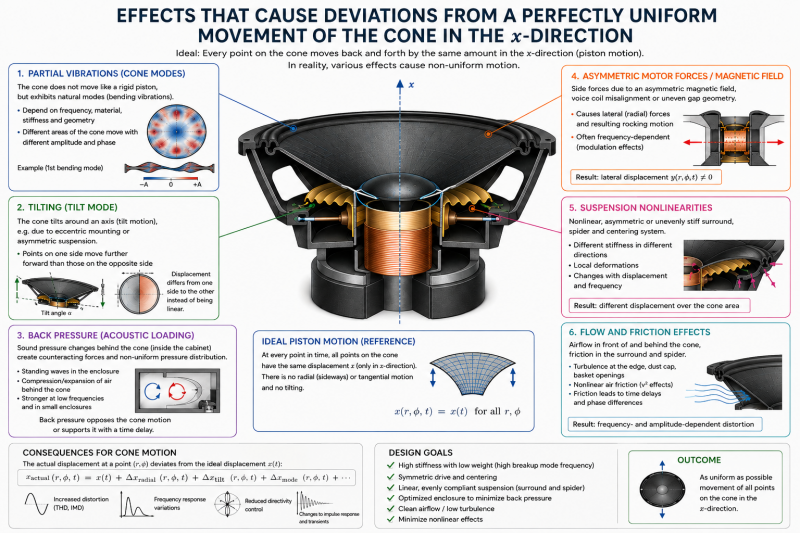
If the driver motor governs motion along the X-axis, the diaphragm itself operates primarily within the Y-Z plane, where it couples mechanical motion to the surrounding air. This interaction fundamentally determines the driver’s acoustic performance. The greater the diaphragm area and the larger its excursion, the greater the volume of air displaced and the higher the attainable sound pressure. However, the amount of air that must be accelerated depends strongly on frequency. Producing low frequencies requires dramatically greater displacement than producing midrange or treble frequencies at the same perceived loudness. A difference of four octaves – for example, between 100 Hz and 1.6 kHz – requires roughly two to three hundred times more kinetic energy to be transferred into the surrounding air. Seen from this perspective, the differences in size and weight between typical bass and midrange drivers are surprisingly modest.
The diaphragm itself now becomes another engineering compromise. Ideally, it should be: extremely light, perfectly rigid, and mechanically durable. Unfortunately, no known material satisfies all of these requirements simultaneously. Increasing stiffness generally increases mass. Reducing mass compromises rigidity and durability.
And now for some thermodynamics and deformations…
The Stubbornness of Air
The surrounding air introduces another set of complications. When the diaphragm accelerates forward, it compresses the air in front of it while simultaneously generating an opposite pressure wave behind it.
If these two sound fields are allowed to meet, they largely cancel one another. This explains why a bare woofer suspended in free air produces remarkably little bass despite substantial diaphragm excursion. Consequently, the rear radiation must be effectively isolated from the listening room, which leads directly to the subject of loudspeaker enclosures – a fascinating field in its own right that lies beyond the scope of this article.
Yet even on the front side of the diaphragm, air refuses to behave as a perfectly obedient medium. Near the centre of the cone, air particles are driven predominantly along the axis of motion. Towards the outer edges, however, the airflow increasingly escapes sideways, generating complex lateral pressure gradients, local turbulence and secondary flow structures. These forces act back upon the diaphragm itself. Instead of experiencing a perfectly uniform load, different regions of the cone are subjected to slightly different pressures and forces at every instant.
From a mathematical perspective, this interaction belongs to the realm of computational fluid dynamics and, ultimately, nonlinear systems with highly coupled boundary conditions. For the loudspeaker designer, however, the practical conclusion is much simpler. A good diaphragm must not only be light and stiff – it must also possess sufficient internal damping to suppress the unavoidable mechanical disturbances generated by its interaction with moving air.
Now That the Cone Loses Its Shape
No loudspeaker diaphragm is perfectly rigid. Every diaphragm, regardless of its material, deforms under load. Several of the forces responsible for these deformations have already been introduced: the restoring forces generated by the surround, aerodynamic forces acting across the diaphragm surface, and the mechanical coupling between the voice coil and the cone itself. As the cone accelerates and decelerates, its inertia prevents every point on the diaphragm from moving identically. Different regions may lag slightly behind or move ahead of others. Consequently, the sound is no longer launched into the air simultaneously across the entire radiating surface. These microscopic timing differences are often far more significant than they first appear. They alter not only the frequency response, but also the transient behaviour and spatial coherence of the reproduced sound. This explains why diaphragm geometry is so important.
The familiar conical shape of a woofer and the dome geometry of a tweeter are not merely aesthetic design choices. Curved surfaces are considerably more resistant to bending than flat ones because part of the applied force is converted into tensile and compressive stresses within the material rather than pure bending moments.
Alternative transducer technologies, such as planar magnetic and electrostatic loudspeakers, address the same problem differently. Instead of relying primarily on geometric stiffness, they attempt to distribute the driving force much more uniformly across the diaphragm surface. While this reduces certain types of deformation, it introduces its own engineering challenges elsewhere in the system.
Finite stiffness gives rise to another phenomenon that is frequently underestimated: cone break-up modes. Whenever the wavelength associated with the reproduced frequency approaches the dimensions of the diaphragm—or one of its characteristic modal shapes—the cone no longer behaves as a rigid piston. Instead, different parts of the diaphragm begin vibrating independently, producing complex bending-wave patterns across its surface. Modern finite-element simulations illustrate these mode shapes beautifully. Large regions of the cone move in opposite directions, separated by nodal lines where little or no motion occurs. The first break-up mode of a typical 300 mm woofer may occur around 1 kHz, whereas the first structural resonance of a dome tweeter generally lies well above the audible range. One might therefore assume that break-up modes are of little practical importance because loudspeaker drivers are normally operated below these frequencies. Reality is less accommodating. Under real operating conditions, break-up behaviour often begins to develop well before the theoretically predicted resonance frequencies. Manufacturing tolerances, boundary conditions, material inhomogeneities and nonlinear loading all contribute to earlier excitation. Furthermore, individual break-up modes can produce local sound pressure peaks exceeding 12 dB, making them clearly audible if not adequately controlled by crossover design or diaphragm damping. Perhaps even more importantly, these structural resonances possess their own temporal behaviour.
Unlike the intended musical signal, they do not stop vibrating immediately when excitation ceases. Instead, they continue to oscillate briefly, releasing stored mechanical energy after the original signal has ended.
This phenomenon—commonly referred to as ringing—represents one of the principal mechanisms by which diaphragm resonances degrade transient reproduction. Consequently, diaphragm materials should not merely maximise stiffness. Equally important is sufficient internal damping to suppress unwanted resonances before they become audible. Once again, loudspeaker design proves to be an exercise in balancing conflicting objectives rather than maximising a single parameter.
So, What Makes a Truly Good Loudspeaker Driver?
To the best of our knowledge, the recipe for the perfect loudspeaker driver has yet to be discovered. Over the past decades, engineers have developed countless innovations aimed at improving performance: sophisticated magnetic circuits that stabilise motor force, copper shorting rings that minimise inductance modulation, sandwich diaphragms combining lightweight cores with stiff outer skins, phase plugs, advanced suspension geometries and numerous other refinements. Each addresses a particular limitation. None eliminates them all. The behaviour of a loudspeaker driver is governed by a remarkably large number of interacting physical phenomena. Many of these interactions become fully apparent only during experimental evaluation, making iterative development an indispensable part of the design process. As a result, even the most expensive loudspeaker drivers represent carefully optimised compromises rather than perfect electroacoustic transducers.
Designing a functioning moving-coil driver is comparatively straightforward. Designing one capable of reproducing music with convincing realism is considerably more demanding. It requires painstaking optimisation of motor geometry, diaphragm materials, suspension characteristics, manufacturing tolerances and quality control – often over many years of development. In our view, the central objective should always be the same: to maximise transient accuracy during the final transfer of energy from the diaphragm into the surrounding air. This goal extends well beyond achieving a smooth frequency response or impressive efficiency figures. It concerns the driver’s ability to preserve the timing relationships contained within the original recording – an objective whose pursuit demands substantial engineering effort without any guarantee of a dramatic commercial breakthrough.
Viewed from this perspective, it becomes easier to understand why certain loudspeaker drivers remain in production, virtually unchanged, for thirty years or more. Some have been rebranded, others copied, yet many continue to enjoy an outstanding reputation among loudspeaker designers. That is not intended as criticism:
Sometimes, engineers just got luckily close to an exceptionally successful compromise.
Can Technical Specifications Tell Us Which Loudspeaker Is Better?
In our experience, truly outstanding loudspeaker drivers – and loudspeakers in general – cannot be identified simply by reading the technical specifications typically provided by manufacturers and retailers. Figures such as sensitivity,
power handling, maximum sound pressure level, or quoted frequency range, provide surprisingly little information about a loudspeaker’s ability to reproduce music convincingly. Even frequency-response and impedance plots, when supplied, are of limited value. They may offer useful guidance for matching loudspeakers with amplifiers or predicting general tonal balance, but they reveal very little about the qualities that ultimately determine whether reproduced music sounds believable.
A somewhat more informative set of parameters are the familiar Thiele-Small parameters. These describe the relationship between the driver’s motor strength, moving mass and suspension compliance, making them indispensable when designing an appropriate enclosure. However, they were never intended to describe the accuracy with which a loudspeaker reproduces music. They cannot reveal how nonlinearities evolve with excursion, how transient behaviour changes at higher output levels, or how faithfully the driver preserves the timing relationships contained in the original signal.
For that purpose, far more sophisticated measurements are required. Among the most informative are the Klippel large-signal parameters, which describe how key driver characteristics vary throughout the entire excursion range.
Rather than measuring a single value for quantities such as motor force, compliance or inductance, the Klippel method records these parameters as functions of voice-coil displacement. This approach not only quantifies nonlinear behaviour but also identifies its underlying causes, enabling engineers to optimise specific aspects of the design. Today, such measurements have become standard practice during the development of high-quality loudspeaker drivers. Unfortunately, they are rarely published and remain virtually unknown to the consumer.
Performing these measurements as part of the regular production process/ quality assurance would also be prohibitively expensive for most manufacturers.
For routine production testing, considerably faster methods are employed. A common procedure involves measuring the driver’s frequency response using swept sine signals and comparing the result with a reference response stored for that particular model. Drivers whose responses deviate beyond predefined tolerances are rejected.
At the very least, such tests should include measurements of harmonic distortion (THD). Even more revealing, however, are measurements that capture the driver’s behaviour in the time domain. Impulse responses, step responses, cumulative spectral decay plots (commonly known as waterfall plots) and other time-resolved measurements expose stored energy, resonances and delayed decay mechanisms that remain largely invisible in conventional frequency-response curves.
Although such measurements require considerably greater effort, they examine precisely those characteristics that determine whether a loudspeaker reproduces music with convincing transient fidelity. For this reason, we believe they deserve considerably more attention than the perfectly flat frequency-response curves so often celebrated in advertising literature. As we shall discuss in the remaining parts of this trilogy, the human perception of sound depends on far more than amplitude alone. Individual hearing characteristics and room acoustics frequently influence the listening experience far more strongly than minute deviations in an anechoic frequency-response measurement.
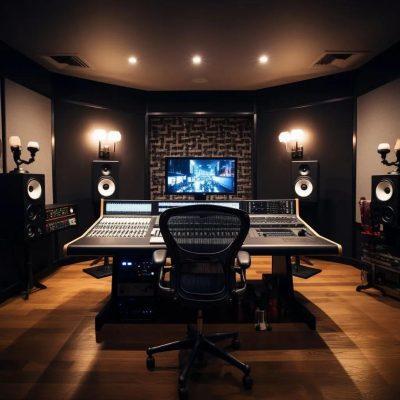
Studio Technology at Home?
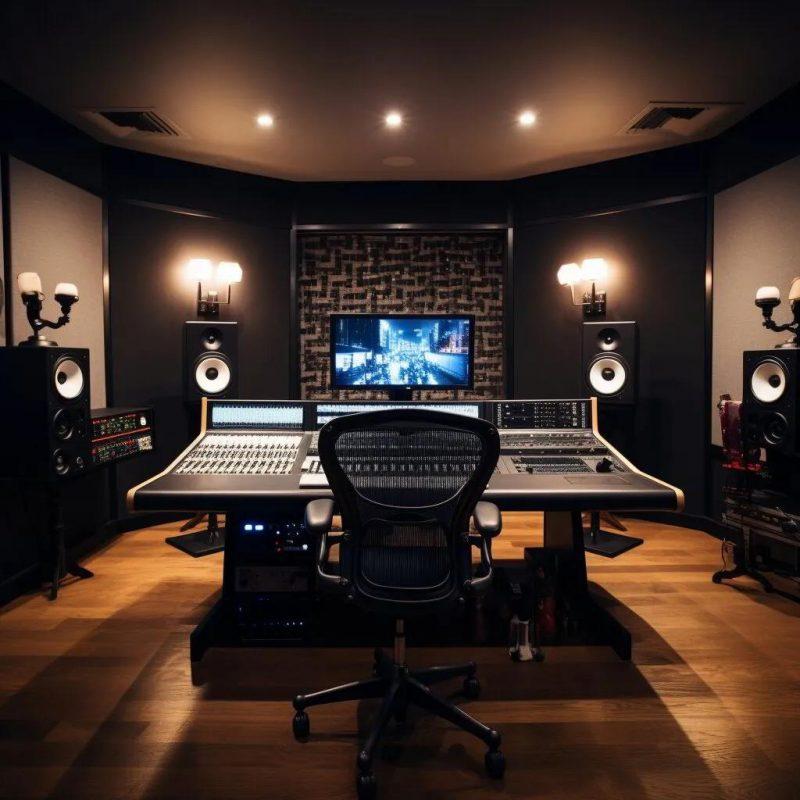
This observation leads to an interesting question. The recordings we enjoy at home were almost certainly created using monitoring systems whose purpose is to reproduce the original recording as accurately as possible. Why, then, should fundamentally different criteria apply when selecting loudspeakers for home listening? Marketing departments have long attempted to distinguish domestic Hi-Fi loudspeakers from professional studio monitors.
To some extent this is understandable. Consumer products often prioritise appearance, compact dimensions and commercial differentiation, whereas professional monitors are designed primarily as precision tools. In the high-end sector, however, where manufacturers frequently claim “absolute fidelity” or “perfect sound reproduction,” this distinction becomes increasingly difficult to justify. Professional monitoring loudspeakers place exceptional emphasis on transient accuracy, time coherence, low distortion, predictable directivity, and consistency between production units. Naturally, a recording studio represents a highly integrated acoustic environment in which loudspeakers and room acoustics are optimised together – often with little regard for domestic aesthetics.
Nevertheless, we believe that music lovers should not hesitate to consider loudspeakers marketed as studio monitors for home listening. Modern digital room-correction systems have become remarkably effective at compensating for many of the acoustic shortcomings found in domestic environments. Combined with loudspeakers whose primary objective is accurate reproduction rather than euphonic coloration, they often provide an excellent foundation for long-term musical enjoyment. Interior design considerations, of course, remain an entirely personal matter.
Conclusion
For many decades, the electroacoustic transducer has remained one of the greatest engineering challenges in high-fidelity audio. Its task appears deceptively simple: to convert an electrical signal into sound. In reality, every loudspeaker driver represents a carefully balanced compromise between conflicting physical requirements.
No amount of marketing can change this fundamental fact. Even the loudspeakers used by recording engineers during the production of our favourite albums are subject to the same physical limitations. From our perspective, the most successful drivers are those that reproduce music with outstanding transient fidelity and time coherence over their intended frequency range and across realistic listening levels. Characteristics such as an exceptionally flat frequency response, high sensitivity or impressive maximum output are of secondary importance if they are achieved at the expense of faithful time-domain behaviour. For this reason, we see no justification for applying fundamentally different quality criteria to domestic loudspeakers than to professional studio monitors.
Unfortunately, the measurements most relevant to these qualities are rarely available to consumers. Consequently, when selecting loudspeakers, careful listening remains indispensable. At 3be audio, we therefore continue to rely on proven driver platforms with established long-term performance records. Every individual driver is measured before installation to ensure that manufacturing tolerances remain within exceptionally narrow limits. Ultimately, authentic music reproduction begins not with particular marketing specifications, but with engineering integrity.
(*) References and Further Reading
E. Geddes: “Audio Transducers”
M. Colloms: “High Performance Loudspeakers”
J. D’Appolito: “Testing Loudspeakers”
D. Self: “Loudspeakers”
R. C. Heyser: “Loudspeaker Phase Characteristics and Time Delay Distortion”
Various AES publications by N. Thiele, R. Small, W. Klippel
Plots and illustrations made with use of AI