



This is the third and final part of our trilogy exploring the fundamental factors that shape our perception of great sound – and how high-fidelity audio systems recreate music in our homes.
Part 1: The impossibility of the perfect sound transducer
Part 2: You hear perfectly… differently
Part 3: You hear how you reside
This article offers an accessible introduction to the many ways in which our listening environment influences the quality of music reproduction in everyday living spaces. It is written for music lovers who enjoy high-quality sound but have little interest in the technical jargon that often dominates discussions of high-end audio – or who remain sceptical of the marketing promises made by the hi-fi and home cinema industries. The physics of sound propagation—and particularly the mathematics used to describe it – can quickly become intimidating. Rather than disappearing into equations, we’ll stay close to the experience that matters most: listening itself. Along the way, we’ll introduce the most important concepts in room acoustics, explain which technical terms are genuinely useful, and help you separate the factors that truly influence musical enjoyment from those that matter far less. For readers who would like to explore the subject in greater depth, we’ve also included references to further reading throughout the article.
When listening through headphones, almost everything we hear consists of direct sound. The distance between the driver and the eardrum is measured in millimetres rather than metres, so only a tiny amount of acoustic energy is required to achieve a comfortable listening level. In fact, producing the same perceived loudness through a pair of loudspeakers positioned three metres away requires roughly 300,000 times more acoustic energy. But loudspeakers offer something headphones fundamentally cannot. Their sound doesn’t reach only our ears—it interacts with our entire body. We don’t merely hear deep bass frequencies; we feel them. Our chest, our skin and also the furniture around us respond to low-frequency sound, creating a sensory experience that more closely resembles listening to live music.
This article is not intended to settle the long-running debate between headphones and loudspeakers. Both have undeniable strengths. Instead, we’ll focus on what happens once music enters a real living room through a pair of high-quality loudspeakers.
What could be more enjoyable than surrounding yourself with great music in your own home? It’s an intentionally rhetorical question. Because from this point onward we’ll spend quite some time discussing all the ways in which a room can make that goal surprisingly difficult.
Before we begin, however, one principle deserves emphasis: A “good” listening room cannot turn a poor hi-fi system into a great one – but a poor listening room can reduce even the finest hi-fi system to a shadow of its true potential.
To illustrate just how significant the room really is, consider a simple example from our own development facilities at 3BE. The figure below shows four frequency-response measurements taken from exactly the same loudspeaker.
Nothing about the loudspeaker changed. Only the microphone position. No elaborate measurement setup was use – just four ordinary listening positions within the same room. The results are striking. Even small changes in listening position produce dramatic variations in sound pressure at individual frequencies. Some frequency bands become noticeably louder, others substantially quieter, while the overall tonal balance changes surprisingly as the measurement position moves from directly in front of the loudspeaker to the normal listening seat.
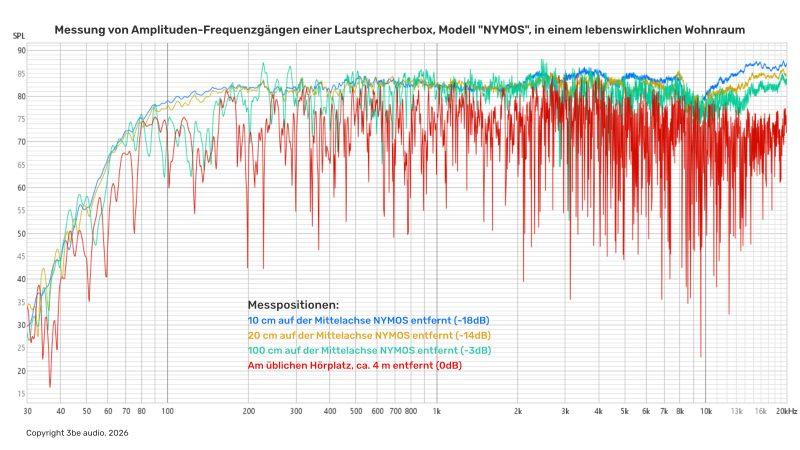
If you’re used to the beautifully smooth frequency-response graphs found in manufacturers’ brochures, the measurements may look almost alarming. Fortunately, appearances can be deceiving. Despite these far-from-perfect measurements, listening to music in our workshop remains an immensely rewarding experience.
Because one simple fact is often forgotten: The room is part of the sound.
The same sound that reaches our ears also excites everything else in the room. Floors, windows, doors, furniture. Every physical object has natural resonances and will vibrate when stimulated by sound. Sometimes the entire object moves as a whole – much like a loudspeaker cone or a playground swing. At other times, the vibrations occur within the material itself, a phenomenon known as structure-borne vibration. These vibrations can be triggered either by a single impulse or by the continuous pressure fluctuations produced by music. Once an object begins to vibrate, it effectively becomes another loudspeaker, radiating sound of its own or transferring vibrations to neighbouring objects. If you’ve ever heard dishes rattling inside a kitchen cabinet during a piece of bass-heavy music, you’ve already experienced this effect. Fortunately, most household objects contain enough mass and internal damping to absorb vibrational energy quickly, converting it into tiny amounts of heat before it becomes audible. Problems arise when this damping is insufficient. A thin wardrobe back panel, for example, may resonate strongly at one or more specific frequencies. The panel itself may not seem particularly loud, yet it can easily excite shelves, doors or the objects stored inside the cabinet – ultimately producing the familiar rattling that many listeners mistakenly attribute to their loudspeakers.
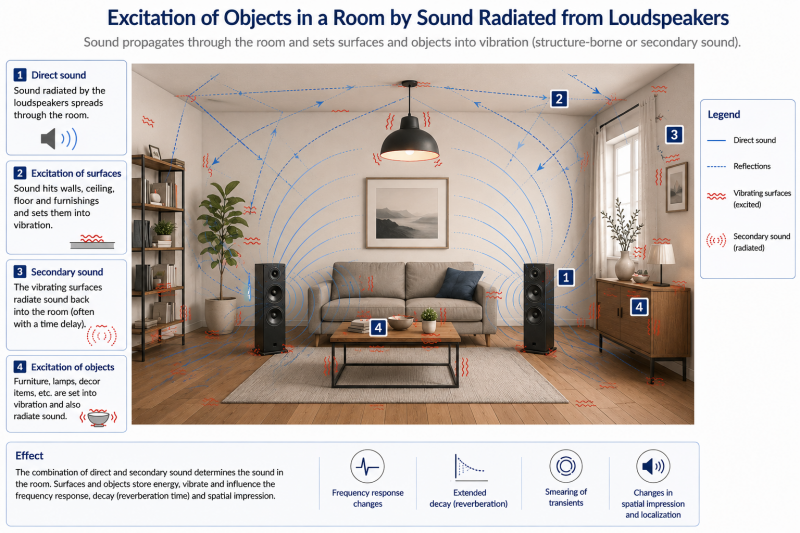
Fortunately, identifying such resonances is relatively straightforward. A slow frequency sweep using pure sine tones below approximately 200 Hz usually reveals the culprit within seconds. The sweep should progress gradually from low to higher frequencies, ideally one hertz at a time, because the resonance of a particular object can occupy an extremely narrow frequency range. Many objects also exhibit additional resonances at integer multiples of their fundamental resonance frequency, although these higher modes are generally less pronounced. The solution is not necessarily to remove the object that is initially excited – few people are willing to replace the wooden floor of a beautiful old house simply for better acoustics. Instead, it is often more effective to interrupt the transmission path.
Returning to our earlier example, the goal may simply be to prevent the cabinet from transferring vibrations to the crockery inside it.
This brings us to one of the most important concepts in room acoustics: Room modes. Room modes are standing-wave resonances that cause certain frequencies – primarily low frequencies – to become dramatically louder or quieter depending entirely on where you are sitting. They influence not only perceived loudness but also the transient accuracy and definition of bass notes.
Most living rooms resemble rectangular boxes. When sound leaves the loudspeakers, part of it is absorbed by walls, floors and ceilings, while another part is reflected back into the room. Because the room has three principal dimensions – length, width and height – it behaves as a three-dimensional resonant cavity. Imagine a room with a ceiling height of 2.5 metres. A sound wave approximately 5 metres long – corresponding to roughly 68 Hz – fits almost perfectly between floor and ceiling. As this wave reflects repeatedly, its peaks and troughs reinforce one another, forming a standing wave. Depending on the height of your ears above the floor, that frequency may become dramatically louder – or almost disappear altogether. The same phenomenon occurs, though progressively weaker, at harmonic multiples of the fundamental room mode. If your listening position happens to be close to a wall, these resonances often become particularly pronounced. The effect is even stronger in corners, where standing waves from several room dimensions overlap simultaneously. The result is familiar to many listeners: Powerful bass in one part of the room… Almost no bass a metre away… And overwhelming boominess in the corners. Fortunately, perfectly symmetrical standing waves are relatively easy to disrupt. Furniture, bookshelves, open doorways and irregular room shapes all interrupt the uninterrupted travel of reflected sound waves. As a result, the resonances become less sharply defined and their influence spreads more evenly across the frequency spectrum. Incidentally, this is one reason why perfectly spherical or circular rooms – sometimes imagined as acoustically ideal – are anything but. Their high degree of symmetry would reinforce resonances in several dimensions simultaneously rather than suppress them.
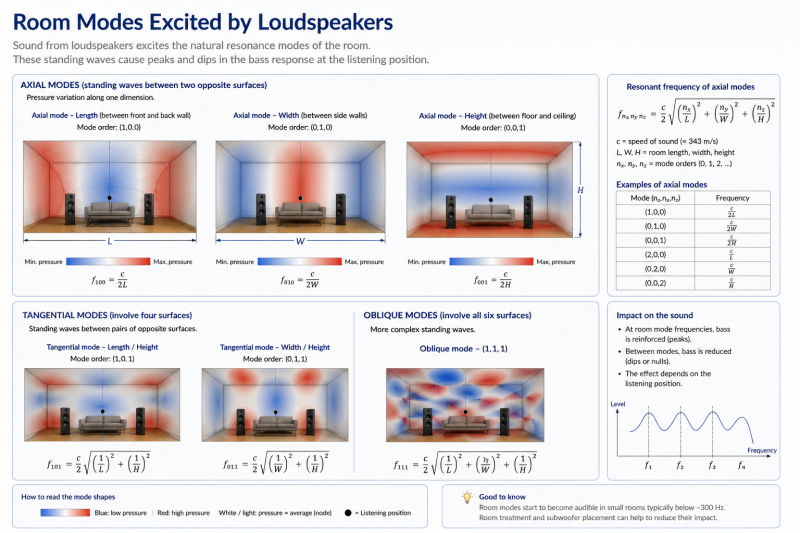
Because room modes depend entirely on position, choosing the listening seat is just as important as choosing the loudspeakers themselves. As a general rule, avoid sitting directly against a wall – or exactly in the centre of the room. Moving the loudspeakers slightly farther away from the front wall can also reduce the excitation of the strongest room modes. Naturally, this introduces other acoustic trade-offs, which we’ll discuss later when we look at loudspeaker placement in more detail. For now, it is enough to remember one simple principle: The bass you hear is determined as much by your room as by your loudspeakers.
One increasingly popular approach to dealing with room modes is the use of a Digital Signal Processor (DSP).
Within certain limits, this approach can be remarkably effective. Our own experience with modern room-correction systems has been positive. When carefully calibrated for the main listening position, they can significantly improve tonal balance by reducing the excessive peaks created by room resonances. It’s important to understand, however, what these systems actually do. Rather than boosting everything else, modern room-correction algorithms primarily attenuate frequencies that the room exaggerates. Today’s DSP systems use sophisticated digital filters – typically Finite Impulse Response (FIR) filters – that can reproduce the measured irregularities of a room with remarkable precision before applying the inverse correction to the signal. The mathematics behind these algorithms is vastly more sophisticated than the simple parametric equalisers familiar from earlier generations of hi-fi equipment. Most modern systems perform these calculations automatically, leaving users with little need – or opportunity – to understand the underlying signal processing in detail. As these technologies continue to evolve rapidly, driven largely by advances in professional studio and live-sound applications, we won’t attempt to explore the mathematics here. For readers wishing to delve deeper, we’ve included a selection of references at the end of this article.
DSP does have one important limitation. Every correction is location-specific. The settings that produce excellent results at the primary listening position – the familiar sweet spot – are unlikely to be equally effective elsewhere in the room. Even more importantly, DSP can do very little to compensate for deep acoustic cancellations. Where a standing wave causes two sound waves to cancel each other almost completely, there is simply very little sound left to amplify. As engineers like to say: Zero multiplied by anything is still zero. Attempting to overcome such cancellations by adding ever more electrical power quickly exceeds both the capabilities of the equipment and the tolerance of anyone sitting away from the calibrated listening position.
If room reflections create problems, why not eliminate them altogether? It’s an understandable question. After all, sofas, curtains, carpets and bookshelves all absorb sound to varying degrees, while large glass surfaces and tiled floors reflect much of it back into the room. Many enthusiasts therefore install bass traps or extensive acoustic treatment in pursuit of greater accuracy. Yet complete absorption is neither practical nor desirable in a normal living space. The reason is simple. Reflected sound is not merely an unwanted by-product of music reproduction. It is one of the primary ways our auditory system understands the size, shape and character of the space around us.
A room without reflections would sound profoundly unnatural. Indirect sound is an essential part of how we experience realism.
This brings us to another key concept in room acoustics: Reverberation time. As the name suggests, reverberation describes how long a sound continues to exist within a room after the original source has stopped. In a theoretically anechoic chamber, the reverberation time is effectively zero. There are virtually no reflections. Only direct sound reaches the listener. Real rooms behave very differently. Every sound we hear consists of direct sound combined with countless reflections arriving from different directions and at slightly different times. Although our brains perceive these reflections as belonging to the original source, they simultaneously provide invaluable information about the surrounding space. Even with our eyes closed, reverberation allows us to recognise whether we’re standing in a small living room, a concert hall or a cathedral.
Unlike room modes, which affect relatively narrow frequency ranges, reverberation influences virtually the entire audible spectrum. Acousticians quantify this using a parameter known as RT”xx”. The measurement is straightforward in principle. A short broadband test signal is played into the room, and microphones record how long it takes for the sound level to decay by “xx”, say 60 decibels – equivalent to a reduction in acoustic energy by a factor of one million. RT60 has become one of the most important objective measures in architectural acoustics and plays a central role in the design of concert halls, recording studios, theatres and public buildings. Measurements are typically performed using broadband noise above approximately 150 Hz, allowing reverberation to be assessed largely independently of low-frequency room modes.
One important characteristic of reverberation is that it is inherently frequency-dependent. High frequencies lose energy much more rapidly than low frequencies, although the exact behaviour depends on the materials present in the room. The more absorbing surfaces a room contains, the shorter its reverberation time. Conversely, larger rooms generally exhibit longer reverberation because sound travels greater distances before encountering absorbing surfaces. This explains why a cathedral sounds completely different from a living room. In Cologne Cathedral, for example, the RT60 approaches ten seconds. Even the very first wall reflections arrive several tenths of a second after the direct sound—wonderful for sacred choral music, perhaps, but hardly ideal for understanding the lyrics of a fast-paced heavy metal song.
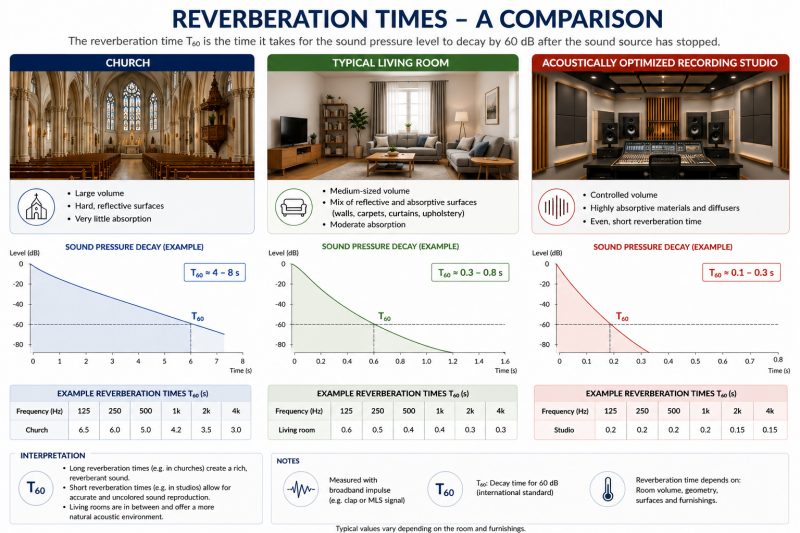
The ideal reverberation time ultimately depends on the room’s intended purpose. Recording studios typically aim for values between 0.15 and 0.30 seconds. Concert halls often target around 2 seconds. For comfortably furnished living rooms, most listeners perceive values between 0.4 and 0.5 seconds as particularly natural. Our own experience at 3BE strongly supports this range. Rooms with reverberation times in this region allow listeners to enjoy virtually every style of music at realistic listening levels without fatigue. Above approximately 0.5 seconds, reverberation gradually becomes an audible component of the sound itself. Some listeners even find this pleasant, as it lends recordings an additional sense of spaciousness or live ambience.
From our perspective, however, once reverberation exceeds roughly 0.8 seconds, authentic loudspeaker reproduction becomes increasingly difficult – regardless of how sophisticated the audio equipment may be.
Contemporary interior design trends -industrial lofts, minimalism and open-plan living – often feature large expanses of glass, polished concrete, tiled floors and other hard, reflective surfaces, combined with relatively little furniture.
From an acoustic perspective, these spaces can be challenging. Reverberation times of well over 0.8 seconds are not uncommon. In such environments, even the finest hi-fi system is likely to serve more as a status symbol than as a source of genuinely satisfying musical reproduction. Unfortunately, this is one problem that DSP cannot solve.
Some digital processors offer listening modes labelled Concert Hall, Jazz Club or Cathedral, but these effects simply add artificial reverberation to the original recording. They cannot remove the reverberation already created by the room itself. You cannot immunise the original signal against its acoustic environment.
Professional sound engineers approach this problem very differently. When optimising speech intelligibility in large churches or improving sound quality in concert halls and sports arenas, they begin with detailed measurements of the room’s reverberation characteristics. One important principle governs all of these applications: The farther listeners are from the sound source, the smaller the proportion of direct sound in what they hear. To compensate, carefully positioned loudspeaker arrays are used to deliver fresh direct sound throughout the venue, reducing the listener’s dependence on distant reflections. Applying the same principle to a domestic listening room would simply mean moving your chair much closer to the loudspeakers. At some point, of course, you may begin to wonder whether headphones would be the more practical solution.
If DSP cannot reduce excessive reverberation, what can? Ultimately, there is only one effective solution: Increase the room’s sound-absorbing surfaces. Deep-pile carpets, upholstered furniture, bookshelves, curtains, large houseplants. All of these help absorb acoustic energy and shorten reverberation time. Importantly, this isn’t simply a matter of visible surface area. A thick sofa owes much of its acoustic effectiveness to the porous material hidden beneath the fabric. Professional acoustic absorbers work according to exactly the same principle. Open-cell foams or fibrous materials force sound waves to travel through a labyrinth of microscopic passages, gradually converting acoustic energy into heat. Today’s architectural acoustic products are available in countless shapes and finishes. With thoughtful design, even a seemingly smooth wall can become acoustically effective without compromising the appearance of a living space.
And the benefits extend beyond music. Rooms with well-controlled reverberation are simply more pleasant places in which to hold conversations.
Few subjects generate as much discussion among stereo enthusiasts as loudspeaker placement. The ideal arrangement, we’re often told, is a perfectly symmetrical stereo triangle, centred within an equally symmetrical room containing an equally symmetrical arrangement of furniture. The reasoning is understandable. If every reflection arriving from the left loudspeaker has an identical counterpart from the right, the phantom images created by a stereo recording should appear exceptionally stable and precisely focused. Unfortunately, reality has other ideas.
The author of this article can report from personal experience that such perfection rarely survives contact with an ordinary family living room. Architectural constraints alone usually make it impossible. And that’s before negotiating with anyone else who happens to share the house. In our own listening room, for example, one loudspeaker stands beside a floor-to-ceiling glass patio door. The other radiates into the open-plan living and dining area. Both are positioned relatively close to the rear wall. Neither occupies exactly the same height. From a textbook perspective, it’s an acoustic disaster. Yet, as we’ve already seen, perfect symmetry is not always desirable anyway. In the case of room modes, excessive symmetry can actually reinforce unwanted resonances. And yet, the latter effect is surprisingly moderate in the author’s home.
Asymmetrical surroundings introduce another important acoustic phenomenon: Comb filtering. Comb filtering occurs whenever a sufficiently strong reflection reaches our ears only a few milliseconds after the direct sound.
Typical reflecting surfaces include hard floors, large windows or bare walls. Because the reflected wave travels a slightly longer path, it combines with the direct sound in a complex pattern of reinforcement and cancellation.
The resulting frequency response resembles the teeth of a comb – hence the name. The effect becomes increasingly significant from the midrange upwards, precisely where our hearing is most sensitive and where spatial localisation depends on the smallest timing differences. Fortunately, the audible consequences are often less dramatic than the corresponding measurements suggest. In our own listening tests, moving the listening position by only a few centimetres can produce dramatically different frequency-response measurements. Yet reproducing equally dramatic audible differences has required extraordinary concentration. Our brains appear remarkably adept at adapting to the acoustic signature of familiar rooms. Without conscious effort, we learn to interpret these reflections as part of the environment in which we are listening.
The situation becomes considerably more complex in stereo or home theatre systems. Now each loudspeaker becomes a potential thread to the other one by itself – including its particular reflections in the room. The phantom images between the loudspeakers depend upon all sets of direct sound and its reflections behaving in compatible ways. Even tiny differences in the distances from each loudspeaker to the listening position introduce additional timing errors. Simply adjusting the balance control cannot solve this problem. Neither, in our experience, can endlessly moving loudspeakers – or chairs – back and forth by a few centimetres. Once again, this is where modern DSP technology has transformed what is practically achievable.
One of the greatest achievements of modern digital signal processing is its ability to manipulate time. Today’s DSP systems can introduce precisely adjustable delays, not only for individual loudspeaker channels but, in sophisticated implementations, even for specific frequency ranges within each channel. Combined with carefully calibrated level adjustments, these time delays make it possible to compensate virtually for many of the asymmetries found in real listening rooms. Differences in loudspeaker placement, unequal distances to the listening position, reflections caused by architectural constraints. All of these can be reduced to a remarkable degree. Modern room-correction systems perform these calculations automatically after a series of acoustic measurements. Even experienced engineers often have little insight into exactly how the algorithms redistribute timing, frequency response and level to achieve their results. For some high-end purists, the idea of allowing software to reshape the original signal remains deeply unsettling.
A loudspeaker radiates sound in almost every direction. Place it very close to a wall and the first reflection becomes so strong – and arrives so quickly – that our hearing can no longer separate it from the direct sound. Acoustically speaking, the loudspeaker behaves less like a point source and more like a much larger radiating surface.
The immediate consequence is familiar. Bass becomes fuller and more powerful. Unfortunately, that additional low-frequency energy comes at a price. Stereo imaging loses precision, phantom images become less stable, and transient accuracy begins to suffer. As the distance between loudspeaker and wall changes, the timing of these early reflections changes as well, altering the overall character of the reproduction.
Reducing low-frequency problems through architectural acoustic treatment is considerably more difficult than controlling midrange and treble reflections. Effective bass absorbers become physically large. Highly specialised resonant absorbers require careful planning and precise installation. There is, however, one surprisingly effective acoustic device that many people already own: A wardrobe. Furniture is often blamed for unwanted rattles and resonances. Yet a large cabinet positioned against a wall – or better still, in a corner – can also act as an efficient bass absorber. Interestingly, this has little to do with filling it with clothes or blankets. Instead, the cabinet itself forms a secondary acoustic system. Sound energy passes through its panels and doors into the enclosed air volume inside, where additional energy is gradually dissipated. Rather than eliminating such furniture from the listening room, it often makes more sense simply to cure the unwanted side effects – tightening loose shelves, securing doors and eliminating rattles – while allowing the cabinet itself to continue contributing beneficial acoustic damping. Sometimes the best acoustic treatment is already standing in the room.
The ordinary living room is where countless laboratory measurements and impressive specification sheets collide with reality. No matter how sophisticated a hi-fi system may be, the listening room ultimately becomes one of its most important components. Fortunately, achieving excellent sound at home does not necessarily require purpose-built listening rooms or expensive architectural alterations. A handful of thoughtful acoustic measures – carefully chosen furnishings, sensible loudspeaker placement and reasonable control of reverberation – can transform even acoustically challenging interiors into remarkably enjoyable listening environments. Once reverberation is brought under control, the remaining decisions – where to place the loudspeakers, where to sit and how far to optimise the system – depend largely on how central music listening is to everyday life. Throughout this series, we have assumed the use of loudspeakers with genuinely excellent transient performance. Beyond that, our own experience at 3BE Audio has led us to one clear conclusion: Modern DSP-based room correction is an extraordinarily powerful tool.
Used thoughtfully, it allows music lovers to overcome many of the acoustic compromises that inevitably accompany real homes. In less-than-perfect listening rooms – and most listening rooms are exactly that – we believe these technologies should be embraced rather than avoided. After all, the goal has never been to preserve an untouched electrical signal. The goal is to create the most convincing musical experience possible.
Heinrich Kuttruff: “Room Acoustics”
Floyd Toole: “Sound Reproduction”
Jens Blauert: “Spatial Hearing”
Leo Beranek & Tim Mellow: “Acoustics: Sound Fields and Transducers”
Trevor Cox & Peter D’Antonio: “Acoustic Absorbers and Diffusers”
Plots and illustrations made with use of AI
This article offers an accessible introduction to the many ways in which our listening environment influences the quality of music reproduction in everyday living spaces.
This article offers an insight into one of the greatest engineering challenges in audio reproduction: the design of loudspeaker drivers – the electroacoustic transducers responsible for converting the electrical output of an amplifier into the sound waves that ultimately reach...

Our venture "3be audio" got its name from our mission statement with regard to the experience that we want to create for lovers of sound and music.
In this article, we explore the fascinating relationship between objective acoustic measurements and the highly subjective way humans perceive sound. It is written for music lovers who are curious about home hi-fi but find themselves discouraged by audiophile jargon or...