



This is the second part of our three-part series exploring the fundamental factors that shape our perception of great sound – and how high-fidelity audio systems recreate it in our homes.
Part 1: The impossibility of the perfect sound transducer
Part 2: You hear perfectly… differently
Part 3: You hear how you reside
In this article, we explore the fascinating relationship between objective acoustic measurements and the highly subjective way humans perceive sound. It is written for music lovers who are curious about home hi-fi but find themselves discouraged by audiophile jargon or skeptical of the marketing claims surrounding high-end audio and home cinema equipment. By the end of this article, you should feel more confident trusting your own ears rather than the opinions of people who are, quite literally, listening from somewhere else. Throughout the article, you’ll also find references to scientific literature for readers who wish to explore the subject in greater depth.
Before discussing how we hear music, it’s worth taking a brief look at how sound itself is measured—and why even objective measurements have limits when it comes to describing our listening experience.
In physics, sound is a vibration travelling through a medium, usually air. More precisely, it consists of alternating increases and decreases in air pressure produced by an energy source—in our case, a loudspeaker. These pressure variations propagate through the air from molecule to molecule in all directions. The speed at which these pressure changes travel is known as the speed of sound. In air, it is approximately 343 metres per second, although temperature and humidity cause small variations of a few percent. In water, by comparison, sound travels at roughly 1,480 metres per second.
The frequency of a sound depends on its wavelength. Shorter wavelengths correspond to higher frequencies and therefore higher musical pitches. Frequency is measured in Hertz (Hz) and simply indicates how many complete vibrations occur each second. For example, 100 Hz corresponds to a wavelength of approximately 3.4 metres in air – 1,000 Hz has a wavelength of roughly 34 centimetres.
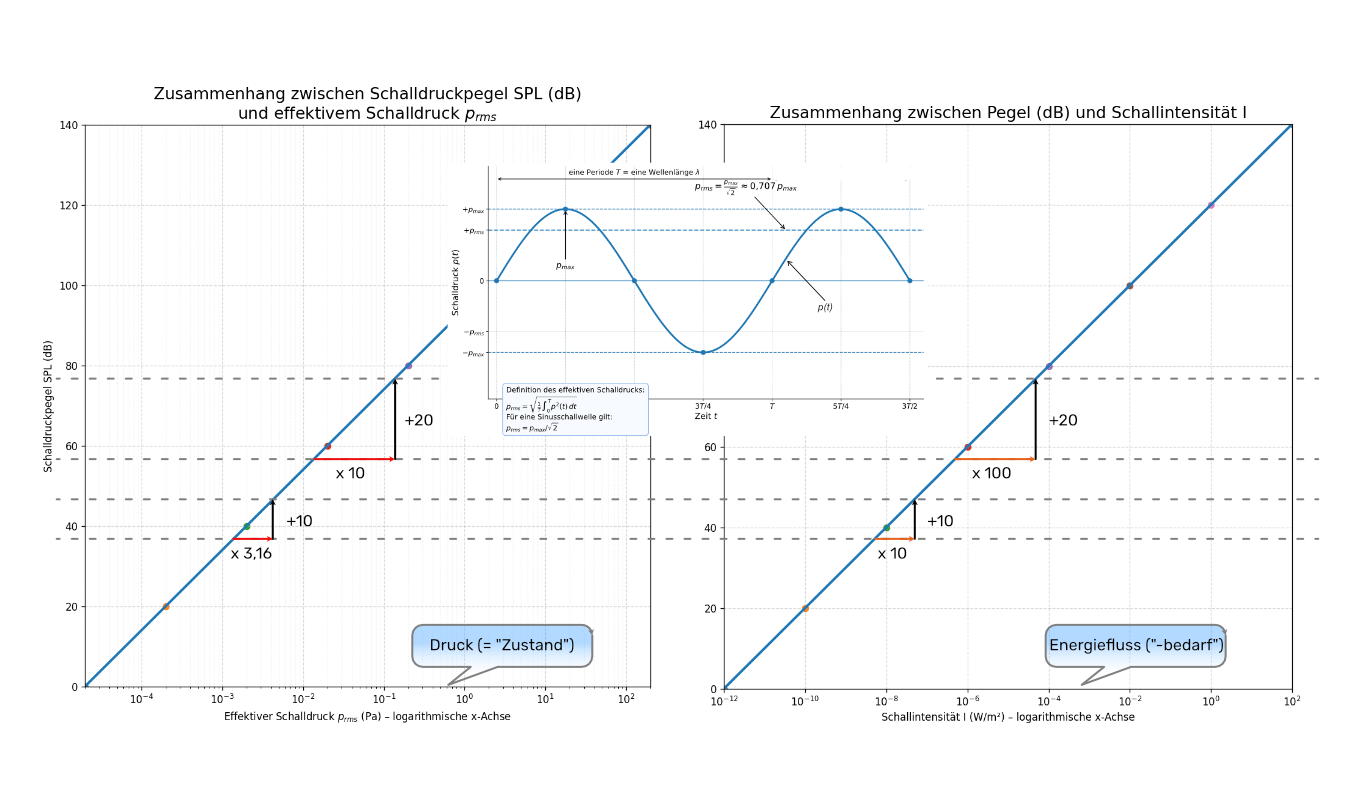
How loud we perceive a sound depends on the amount of acoustic energy reaching our ears. Physically, this is related to the amplitude of the pressure wave – that is, the difference between its maximum and minimum pressure. Describing these pressure fluctuations mathematically quickly leads into the complex world of fluid dynamics. Fortunately, acoustics provides a much more practical approach. Instead of dealing directly with pressure values, engineers usually express sound level in decibels (dB).
The most common quantity is the Sound Pressure Level, or dB SPL. A microphone measures the tiny pressure fluctuations in the air, from which both amplitude and frequency can be determined. These measurements are then converted into a logarithmic scale that is much easier to interpret. The pressure variations associated with audible sound range from roughly 20 micropascals – the threshold of hearing for a healthy young listener at 1 kHz – to about 20 pascals, close to the threshold of pain.
Compared with normal atmospheric pressure of around 100,000 pascals, these fluctuations are astonishingly small. Because the range is so enormous, acousticians use a logarithmic scale. The decibel allows both engineers and listeners to describe extremely quiet and extremely loud sounds using manageable numbers, while also making many physical relationships easier to visualize.
Although sound pressure is an objective physical quantity, measurements are never entirely independent of environmental conditions. Temperature, humidity and atmospheric pressure all influence sound propagation slightly. Humidity, for example, affects the way air absorbs high frequencies. Warm, humid air attenuates treble somewhat differently than dry air. Under everyday listening conditions these effects are usually very small, but they illustrate an important point: Even the physical measurement of sound is never completely isolated from its environment.
If acoustics studies sound itself, psychoacoustics studies how humans perceive it.
Compared with loudspeaker engineering, psychoacoustics is a remarkably young and still evolving discipline. We still do not fully understand how the auditory system transforms tiny pressure fluctuations at the eardrum into our rich perception of voices, instruments, spaces and musical emotion. Much of today’s knowledge comes not from mathematical theory but from carefully controlled listening experiments involving large numbers of test subjects. These studies form the basis of many international standards used throughout professional audio engineering.
However, as it was in any of the above studies, no two listeners have exactly the same hearing characteristics. Differences in ear anatomy, age, experience and even momentary physical condition all influence how we perceive sound. This is why two perfectly healthy people can honestly disagree about the sound of the same loudspeaker. Rather than discussing every aspect of psychoacoustics, we’ll focus on a few key concepts that are particularly relevant to enjoying music at home – and explain why nobody else can define “good sound” for you.
The human ear is remarkably sensitive – but not equally so across all frequencies. Most people can hear sounds between approximately 20 Hz and 20 kHz, although the exact range varies considerably from person to person, changes with age, and can even fluctuate during the course of a single day.
More importantly, our ears are not equally sensitive to every frequency. The pioneering work of Harvey Fletcher and Wilden A. Munson in the 1930s – and later refinements by Robinson & Dadson and the current ISO 226 standard – demonstrated that the same physical sound pressure is not perceived as equally loud at different frequencies. The result is a family of curves known as equal-loudness contours (formerly called isophones). These curves describe combinations of sound pressure and frequency that listeners perceive as equally loud. They have become a cornerstone of modern acoustics, hearing research, and audio engineering. Applications range from hearing tests to noise assessment and loudness compensation in amplifiers.
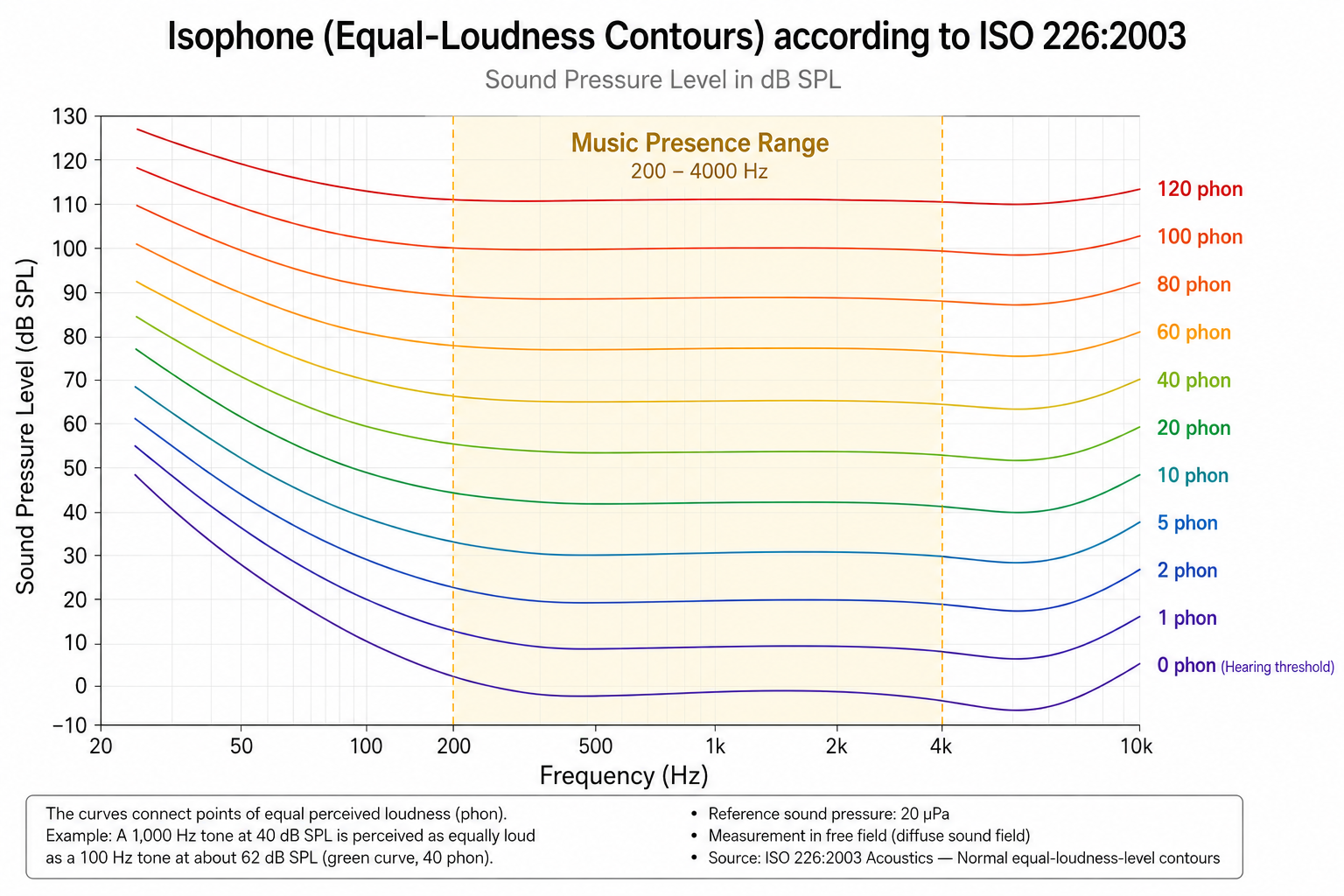
What interests us most, however, are three important conclusions.
First: Everyone’s Equal-Loudness Curves Are Different. The standardized curves published in ISO 226 represent an average over many listeners. Individual hearing can differ considerably. Within the frequency range most important for music – the presence region, roughly between 200 Hz and 4 kHz – healthy listeners commonly differ by as much as ±5 dB from the standardized curves. Outside this range, particularly in the bass and treble, the variation is often even greater. This immediately leads to an uncomfortable truth for anyone pursuing “perfect” sound reproduction: Even if a recording were reproduced with absolute technical accuracy, two listeners would still experience it differently.
Second: You would have recorded it differently. The mastering engineer who balanced your favorite album almost certainly heard it differently from the way you do at home. Not because one of you is right and the other is wrong, but because human hearing itself is not standardized. Your ears are unique.
Third: There Is No Universal Definition of “Perfect Sound”. Since every listener hears differently, there can be no single objective definition of what sounds best. Measurements remain invaluable – but ultimately they describe loudspeakers, not listeners.
Another fascinating concept in psychoacoustics is the Just Noticeable Difference, usually abbreviated JND. It describes the smallest change in a sound that a listener can reliably detect. Researchers have measured JNDs for many aspects of sound, including frequency, loudness, distortion, modulation, and many other acoustic parameters.
The human ear is astonishingly sensitive. Within the presence region, most people can detect frequency changes of less than one percent, and trained listeners often achieve sensitivities close to 0.1%. At 1,000 Hz, for example, a frequency shift of only a few hertz may already be audible. This remarkable sensitivity explains why we instantly recognize when a musical instrument is slightly out of tune. It also explains why certain loudspeaker designs can subtly alter the character of music. For example, when a single loudspeaker driver reproduces both deep bass and midrange simultaneously, the large bass excursion slightly modulates the higher frequencies – a phenomenon related to Doppler distortion. Although this effect is rarely perceived consciously in isolation, it can contribute to the impression that an instrument or voice sounds just a little less natural. Our brains are extraordinarily good at recognizing familiar timbres. Even listeners with no technical background usually have an intuitive sense of whether a voice, a cello, or an acoustic guitar sounds “right.”
The JND for loudness is equally revealing. In the presence region, listeners can often detect level differences smaller than 1 dB. In the deep bass and extreme treble, however, differences of 3 dB or more may be required before they become noticeable. This has an interesting implication for loudspeaker measurements. Audiophile discussions often obsess over perfectly flat frequency-response curves. In reality, small deviations from absolute flatness are usually far less important than many people assume. What deserves closer attention is the overall shape of the response – particularly through the presence region.
Many commercial loudspeakers exhibit a gentle dip here, creating the familiar “smile-shaped” or loudness curve response: boosted bass and treble with a slightly recessed midrange. This tuning often sounds immediately pleasant. We would compare it to adding extra sugar to food. It is enjoyable at first, but it can also mask subtle musical details. Even a seemingly modest reduction of just 1 dB in the presence range can noticeably diminish the richness of voices and acoustic instruments, while simultaneously making imperfections in the loudspeaker itself less obvious.
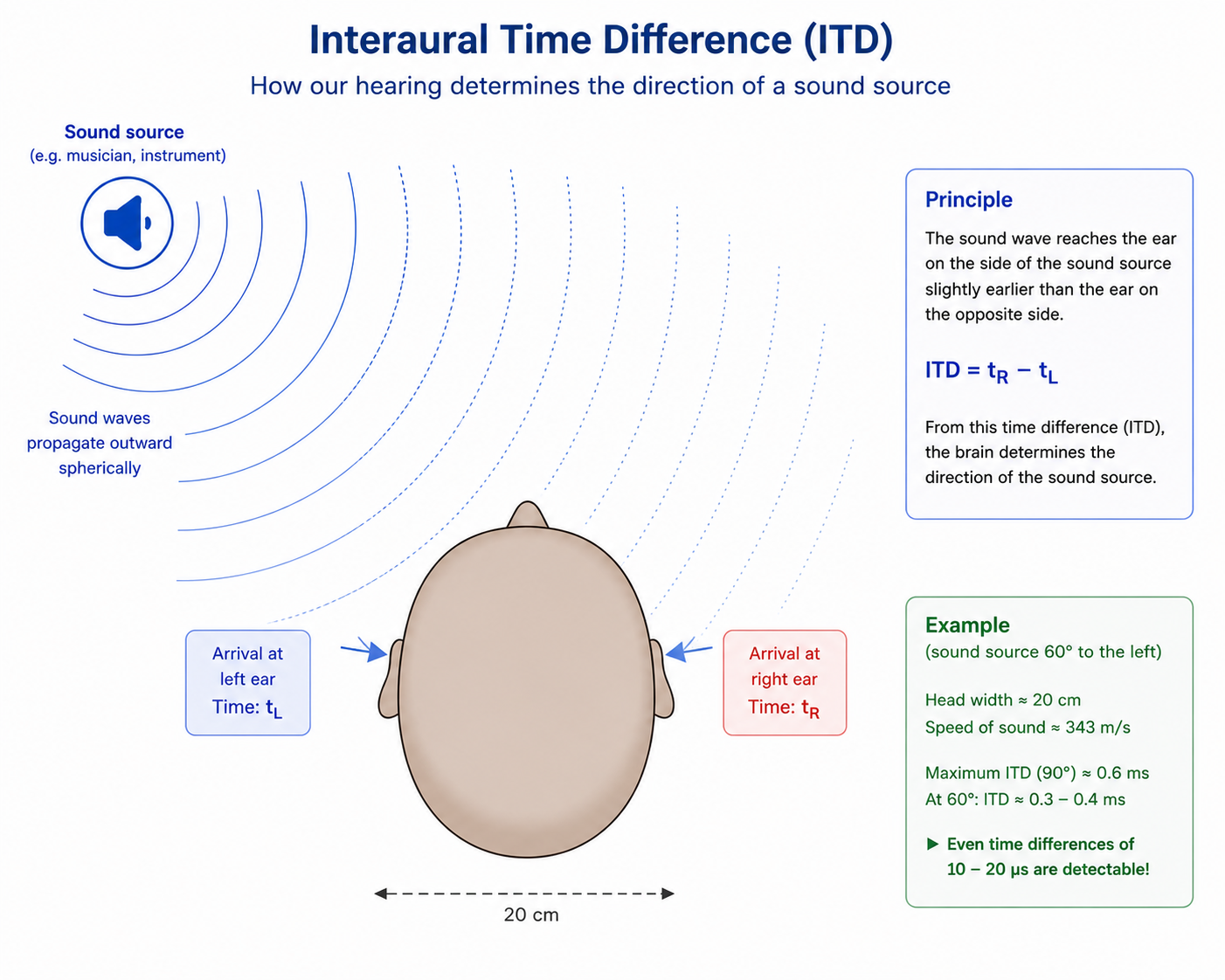
One of the most remarkable abilities of human hearing is its sensitivity to timing. To determine where a sound comes from, our brains primarily compare the arrival times of the sound at our two ears. This cue is known as the Interaural Time Difference (ITD). The maximum natural delay between our ears is only about 0.6 milliseconds, corresponding to a sound arriving from directly to one side of the head. Despite these tiny time differences, we can localize sound sources with extraordinary precision. This ability is fundamental to stereo reproduction.
The convincing illusion of a singer standing between two loudspeakers – or an orchestra spread across a virtual stage – is created almost entirely by carefully controlled timing and level differences between the two channels. Because our hearing is so sensitive, moving only a few centimeters away from the center listening position can noticeably alter the perceived location of these phantom sound sources. Fortunately, enjoying music does not require sitting perfectly motionless between two loudspeakers. The greater challenge lies elsewhere.
Throughout the entire audio chain – from the recording to the loudspeaker itself – small timing errors can subtly disturb the original temporal structure of the music. These errors may arise from crossover networks, multiple drivers, horn geometries, waveguides, diaphragm resonances, or other aspects of loudspeaker design. Interestingly, listeners often recognize such differences immediately during direct comparisons, even without any technical training. The sound may not appear obviously distorted, but it often loses a certain sense of realism, precision, or effortless coherence. Only after prolonged listening do we usually become consciously aware of what initially felt like nothing more than a vague sense that “something isn’t quite right.”
Have you ever wondered how a tiny Bluetooth speaker or a car audio system can seem to produce surprisingly deep bass? The answer lies in one of the most fascinating capabilities of human hearing. Our brains can reconstruct parts of a sound that are physically missing. This phenomenon is known as the missing fundamental.
Imagine an organ pipe producing a low A at 55 Hz. A very small loudspeaker may be physically incapable of reproducing such a low frequency. Yet many listeners still perceive the correct musical pitch. How is that possible? The reason is that musical instruments do not produce just a single frequency. They generate a rich pattern of harmonics – whole-number multiples of the fundamental frequency – that define their characteristic timbre. Most of these harmonics lie within the frequency range where human hearing is particularly sensitive. Our auditory system uses this harmonic pattern to infer the missing fundamental, effectively reconstructing the original pitch in the brain. It’s an extraordinary example of how hearing is an active process of interpretation rather than passive measurement.
Of course, this reconstruction has its limits. The missing bass is not truly there – it is being inferred. Maintaining this illusion also requires additional cognitive effort, which is one reason why listening to heavily processed sound for long periods can become surprisingly fatiguing. Modern signal processing increasingly exploits this phenomenon. Many compact speakers deliberately enhance harmonic content or apply dynamic processing so that listeners perceive more bass than the hardware can physically reproduce. These technologies are remarkably effective, especially in portable speakers and automotive audio systems. Nevertheless, they remain intelligent approximations rather than genuine low-frequency reproduction. A direct comparison with a loudspeaker capable of reproducing the full bass spectrum usually makes the difference immediately obvious – even to listeners with no technical background.
After discussing so many limitations of measurements and hearing alike, one obvious question remains: How should we actually judge the quality of a hi-fi system?
Our most important message is this: Never underestimate your own hearing. Many people say, “I’m not really trained to hear these differences.” In our experience, that simply isn’t true. Your hearing is the final judge of every measurement – whether or not it happens to match a statistical average. And your musical preferences are entirely legitimate. You don’t need to listen to avant-garde jazz or compare twenty different recordings of the same symphony to evaluate a hi-fi system. Any recording – adequately familiar to you – can reveal just as much as an audiophile recording.
One of the best ways to evaluate audio equipment is surprisingly simple. Create a playlist of five to ten songs that you know extremely well. Choose recordings you’ve lived with for years – music whose voices, instruments and overall character you instinctively recognize. They don’t have to be audiophile productions. In fact, older or technically imperfect recordings are often even more revealing because their imperfections become excellent reference points. Then listen to those same tracks on as many different systems as possible. Visit friends. Visit dealers. Attend demonstrations. Build your own mental ranking. Over time, you’ll develop a much more reliable understanding of what genuinely appeals to you than any specification sheet or online review could ever provide.
If you’re new to critical listening, don’t begin with spectacular bass or sparkling treble. Those qualities are often the easiest to manipulate – and therefore the easiest to misjudge. Instead, concentrate on the presence region, where our hearing is most sensitive. Pay attention to human voices, saxophones, cellos, acoustic guitars and piano, snare drums, and – in classic rock songs – to the electric guitars. These instruments quickly reveal whether a loudspeaker sounds lively, natural and expressive – or compressed, homogenized and somewhat artificial. By contrast, first impressions of very deep bass or brilliant treble are often heavily influenced by room acoustics, system settings and even your mood that day. These aspects can frequently be adjusted later. The authenticity of voices and acoustic instruments is much harder to fake.
Objective measurements are enormously valuable. The problem is not that measurements are useless. The problem is that the specifications typically published by manufacturers rarely tell the whole story. Power ratings, frequency-response graphs and distortion figures often look almost identical for products that sound remarkably different. For loudspeakers, this deserves a separate discussion – which is exactly why we devoted another article in this series to loudspeaker design.
As for amplifiers and digital source components, today’s market is crowded with products based on mature digital and Class-D technologies. Many perform exceptionally well. When specifications fail to distinguish between them, practical evaluation becomes essential. Mechanical build quality, thoughtful engineering and a well-designed power supply often reveal more about a component than pages of marketing claims.
We suspect that enthusiasts devoted to analogue hi-fi have long since developed their own judgement when it comes to identifying truly well-engineered equipment, and are therefore unlikely to need our more general guidance. Needless to say, this is not intended to imply any preference for digital audio over analogue. Both technologies have their merits, and our aim here is simply to discuss how to recognise quality, regardless of the underlying technology.
No one’s hearing is too poor to distinguish genuinely excellent sound from merely average reproduction. Our experience at 3be audio, together with decades of psychoacoustic research, suggests that one characteristic above all others determines long-term listening satisfaction: Temporal accuracy.
When a loudspeaker preserves the timing relationships within the musical signal, many other aspects of natural reproduction tend to fall into place as well. Unfortunately, this is precisely the characteristic that conventional specification sheets rarely describe. That is why our advice is:
Listen for yourself.
Listen carefully.
Listen repeatedly.
And trust your own ears more than anyone else’s.
Brian C. J. Moore: “An Introduction to the Psychology of Hearing”
Hugo Fastl & Eberhard Zwicker: “Psychoacoustics: Facts and Models”
B. Gabriel, B. Kollmeier & V. Mellert: “Influence of Individual Listener, Measurement Room and Choice of Test-Tone Levels on the Shape of Equal-Loudness Level Contours”
Jens Blauert: “Spatial Hearing: The Psychophysics of Human Sound Localization”
Richard M. Warren: “Perceptual Restoration of Missing Speech Sounds”
Plots and illustrations made with use of AI
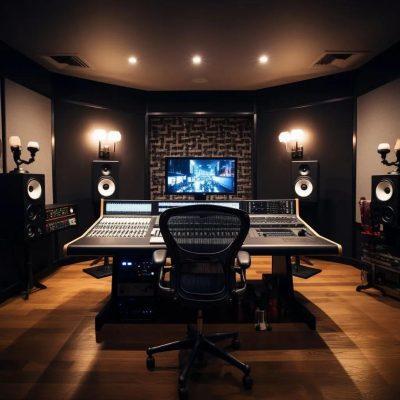
This article offers an accessible introduction to the many ways in which our listening environment influences the quality of music reproduction in everyday living spaces.
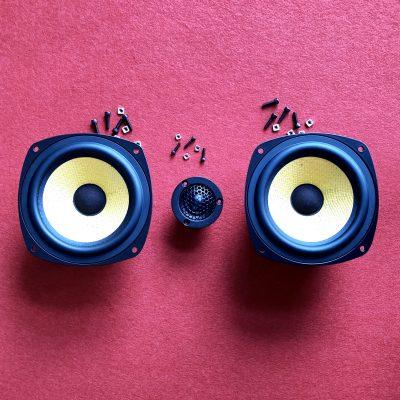
This article offers an insight into one of the greatest engineering challenges in audio reproduction: the design of loudspeaker drivers – the electroacoustic transducers responsible for converting the electrical output of an amplifier into the sound waves that ultimately reach...

Our venture "3be audio" got its name from our mission statement with regard to the experience that we want to create for lovers of sound and music.
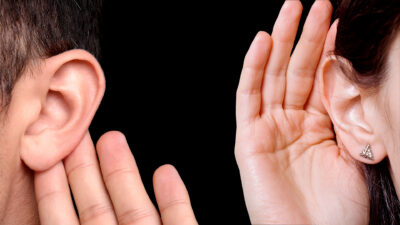
In this article, we explore the fascinating relationship between objective acoustic measurements and the highly subjective way humans perceive sound. It is written for music lovers who are curious about home hi-fi but find themselves discouraged by audiophile jargon or...